
History of the Diocese
An Historical Perspective
Saint Mark the Evangelist was the first Bishop of Alexandria, all of Egypt, and several nearby territories. Collectively, these are called the "See of Saint Mark." Bishops resided in large cities to be close to the seat of local rulers in order to facilitate communication with civil authorities in the Roman Empire.
After the Arab conquest of Egypt, the seat of power moved to El Fostat, the region of the current capital of Cairo. Consequently, the Bishop (Pope) of Alexandria moved to Cairo, though his title remains "Pope of the Great City of Alexandria and Patriarch of the See of Saint Mark."
Other bishops were ordained in various large cities in Egypt over the centuries. The number of bishops varied according to population shifts. Internal movements of Copts, prominence of new cities, and the disappearance of others for economic and demographic reasons led to changes in boundaries and the number of dioceses over the centuries.
The boundaries, however, were solidified in the 19th century during Mohammed Ali Pasha's rule from 1805-1848, following the new railroad route in Southern Egypt and the branches of the Nile in the Delta. There are many more Christians in the south than in the Nile Delta, which is reflected in the greater number of dioceses.
Also, in the second of the 20th century, many services were evolving that we note limited geographical location and therefore needed special attention and expertise. Thus was born the idea of a general bishop responsible for certain services rather than for defined geographical boundaries. The first two general bishops were ordained on September 30, 1962 by the thrice blessed Pope Kyrillos VI. These were Bishop Shenouda for Church Education and Seminaries (currently His Holiness Pope Shenouda III) and Bishop Samuel for Public, Ecumenical, and Social Services (d. 1981). Soon thereafter, many more general bishops were ordained, such as a general bishop for Youth Services, Higher Theological Studies, and other general services.
The general bishop serves wherever there are needs and reports to the Pope directly. As new services evolve, he may move temporarily to serve where there is a need, including services overseas. A general bishop can also be called to serve a diocese permanently and thus become a diocesan bishop for the remainder of his life.
His Grace Bishop Serapion was ordained in 1985 as a general bishop for Public, Ecumenical, and Social Services. In that capacity, he was responsible for a multitude of social services, including management of grants from international organizations for services across Egypt. He was also heavily involved in ecumenical bodies as a representative of the Coptic Orthodox Church. The latter responsibility afforded the opportunity to travel around the world to attend meetings and to participate in policy making, being a member of the central committees of several organizations.
A New Diocese and Bishop
His Holiness Pope Shenouda III discussed the desire for a diocese for Southern California with the clergy during his visit to New Jersey in September 1995. He suggested the name of His Grace Bishop Serapion, who had accompanied His Holiness on his visits from 1989 to 1995 and was well-known to them. The clergy joyfully agreed. A petition was circulated and signed by the congregations of the various parishes in Southern California and sent to Cairo.
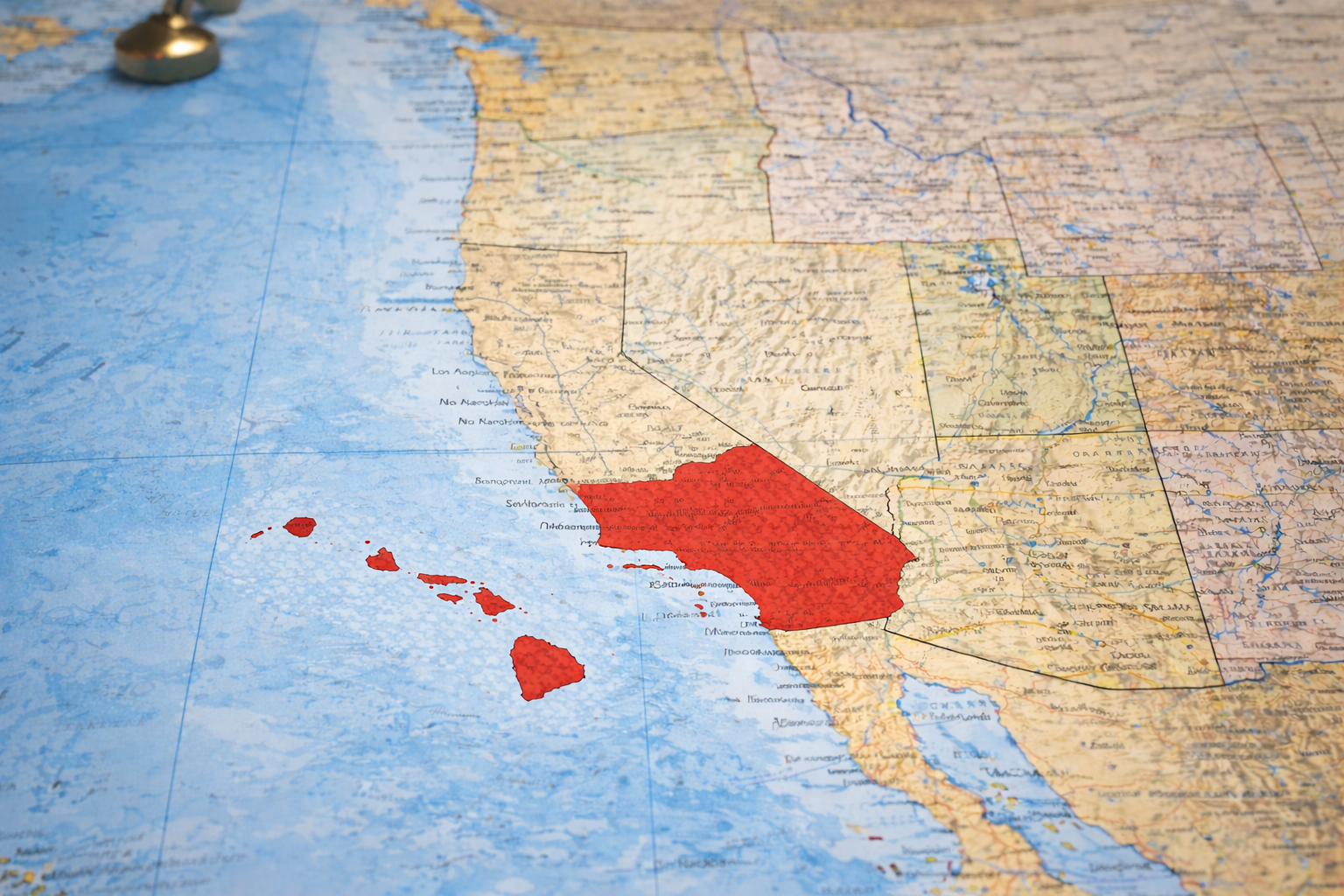
His Holiness called upon HIs Grace Bishop Serapion, who was then General Bishop of Public, Ecumenical, and Social Services, to be the Bishop of Los Angeles, Southern California, and Hawaii on November 14, 1995. At the same time, he called upon His Grace Bishop Youssef, who was then a general bishop serving the southern United States, to head a new diocese that encompassed the southern states from Arizona to Florida.
A celebration was held at Saint Mark's Cathedral in Cairo, after which His Grace spent a few weeks transferring responsibilities and preparing for his journey to California.
On December 23, 1995, His Grace arrived and was warmly received by the congregations of the various parishes. The enthronement ceremony took place on the same day at Holy Virgin Mary and Saint Pishoy Coptic Orthodox Church in Los Angeles. Across the street, a residence for His Grace had been prepared ahead of time.
Adapted from Khalil, Dr. Elhamy. The Making of a Diocese. Los Angeles: Coptic Orthodox Diocese of Los Angeles, 2008.
The Enthronement Ceremony
Holy Virgin Mary and Saint Pishoy Coptic Orthodox Church in Los Angeles was adorned throughout with arches of palm tree branches for the enthronement of His Grace Bishop Serapion. Over 100 deacons from all of the parish churches and all the priests were waiting for His Grace's arrival. Accompanied by six bishops, His Grace entered into a church filled to capacity with over 1,000 persons.
The six bishops accompanying His Grace were Their Graces Metropolitan Hedra of Aswan (where His Grace grew up); Bishop Sarapamon, the head of the Monastery of Saint Pishoy, where His Grace spent several years as a monk; Bishop Ruiess, a general bishop; Bishop Mettaous, the head of the Monastery of Saint Mary in Wadi El Natrun (also known as Deir El Suryan); the late Bishop Karas, head of Saint Antony Monastery in Yermo, California; and Bishop Youssef, bishop of the newly formed Diocese of the Southern United States.
The bishops took turns reading the Proclamation of Enthronement in both Arabic and English. Afterwards, they all signed the proclamation. Short speeches were delivered by His Grace Bishop Ruiess on behalf of the bishops; by Hegumen Father Antonios Younan Soliman on behalf of the priests in English; and by Father Bishoy Mikhail Brownfield on behalf of the priests in English. Gaby Rafael spoke on behalf of the laymen while Mark Hanna spoke on behalf of the youth.
His Grace Bishop Serapion then spoke in both Arabic and English, giving thanks to God for the blessing he received, to His Holiness for his trust, and to all the bishops, priests, and people who welcomed him. He then spoke about love, quoting extensively from the First Epistle of Saint John. He said he planned as much as possible to visit and know all the parishioners in the Diocese. Also, he mentioned three areas in which he is especially committed to the service:
- Serving the youth, the future of the Church, in this difficult and tempting atmosphere
- Family stability, which, in turn, helps children grow in a wholesome atmosphere and leads to church stability
- Communion with the mother church in Egypt. He said that we need them more than they need us. The bond of love and service should be kept strong by all possible means.
Following the conclusion of the service, he stood to greet everyone in the church for almost one hour. It was a truly happy occasion and a new chapter in the life of the Copts and their parishes in Southern California.
Adapted from Khalil, Dr. Elhamy. The Making of a Diocese. Los Angeles: Coptic Orthodox Diocese of Los Angeles, 2008.
Document for the Establishment of the Diocese of Los Angeles, Southern California and Hawaii
As the number of our Coptic Orthodox Churches in the USA has vastly increased, and they have become in great need of bishops to pastor them and oversee their ministry; and as the ministry in the region of Los Angeles has grown considerably, and the number of its churches and priests had increased, and as it has become adequate to become a diocese, extending to Honolulu, thus we have seen fit to send a Bishop to pastor it, and we have selected for this purpose:
His Grace Bishop Serapion who was nominated by the priests and congregation of Los Angeles, after they had learned of his virtues, and because he pastorally cared for the Bishopric of Public, Ecumenical and Social Services very successfully over a period of ten years, since his ordination in 1985.
Therefore we have installed him Bishop over this diocese, in the presence of over fifty bishops, and his title now reads:
Bishop of Los Angeles, Southern California and Hawaii
This diocese currently includes the following churches: St. Mark Church and St. Mary Church in Los Angeles, St. George Church in Bellflower, Archangel Michael Church in Orange County, St. Athanasius Church in the San Fernando Valley, St. John the Beloved Church in Covina, St. Mercurious (Abu-Seffein) and St. Abraam Church in Torrance, St. Mina Church in Riverside, Archangel Michael Church in Ventura, St. Abanoub Church in Corona, Sts. Peter and Paul Church in Santa Monica, St. Demiana Church in San Diego, and St. Mary Church in Victorville. Also included in the diocese are: Palmdale, Bakersfield, and all Southern California, reaching to Hawaii.
His Grace Bishop Serapion has become Bishop of this diocese, and has become the head of its priests. Within his priestly authority now is the ordination of priests and deacons, at all of their ranks, as well as to promote them, and to hold them accountable. He may consecrate churches, altars, baptismal fonts, and icons, as well as any altar utensils. He may also manage the affairs of the Churches within his diocese pastorally, financially, and administratively, and may form church boards and head them. He may organize church education, social services, and all that is connected with his churches.
We send him to you our beloved children with several of the Church’s bishops, for his installment. We call you to treat him as children treat their fathers, with all obedience and submission, and with all respect to his priesthood. Co-operate with him in all that he does for the Church in terms of order, placing before you the words of the saints, “Blessings descend upon those who are obedient.”
May God of Heaven, the Lord of the Church, assist you with His Holy Spirit and the work of His Grace, and may we always hear good news regarding you.
Signatures
Pope Shenouda III
Pope of Alexandria, and Patriarch of the See of St. Mark
We have installed our beloved brother, His Grace H.G. Bishop Serapion, on his throne, in his diocese in Los Angeles, U.S.A. Dated this twenty-third day of December 1995 A.D. (the thirteenth day of Kiahk, 1712 A.M.)
H.G. Bishop Sarapamon, Bishop and Head of the Anba Pishoy Monastery
H.G. Bishop Hedra, Bishop of Aswan
H.G. Bishop Matteos, Bishop and Head of the Monastery of Sorian
H.G. Bishop Rueiss, General Bishop
H.G. Bishop Youssef, Bishop of Southern U.S.A.
H.G. Bishop Karas, Bishop and Head of St. Antony Monastery in California